

The Real Challenge Isn’t Distance – It’s Alignment
Remote employee tracking often gets a bad rap, conjuring images of Big Brother-style surveillance. But here’s the truth: accountability in distributed teams isn’t about watching every keystroke. It’s about creating visibility where physical proximity once provided it naturally.
When your team worked in the same building, you could glance over and see who was swamped, who was stuck, and who needed a nudge. That ambient awareness is gone. In its place, you need intentional systems that answer three critical questions: What is everyone working on? Are we moving toward the same goal? Is anyone blocked? Remote employee tracking tools, answer these questions without turning into invasive monitoring. Think of them as the digital equivalent of that quick “How’s it going?” check-in, except scalable across continents and time zones.
Start with Clarity, Not Control
Before you implement any tracking tool, get brutally clear on expectations. A Stanford study found that unclear goals are the top productivity killer for remote teams, not distractions or lack of oversight. If your team doesn’t know what “done” looks like, tracking their activity is just noise.
Set outcome-based goals rather than activity-based ones. Instead of “Log 8 hours daily,” aim for “Complete three feature tests by Thursday EOD Pacific Time.” Notice the specificity?
That’s intentional. Vague deadlines like “end of the week” are accountability black holes when your week ends on Friday in New York but already started on Monday in Sydney. Use shared project management platforms to create a single source of truth. Everyone, regardless of time zone, can see what’s due, who’s responsible, and what’s been completed. Transparency becomes your accountability superpower.
Async Communication: The Unsung Hero
Synchronous meetings, those real-time video calls, are tempting when you want to “stay connected.” But they’re also productivity kryptonite for global teams. Someone is always sacrificing sleep, family time, or focus hours to accommodate a meeting that could’ve been an email.
Enter asynchronous communication: the practice of working and communicating without requiring everyone to be online simultaneously. Tools like Loom (for video updates), Notion (for shared documentation), and Slack threads let your team collaborate across time zones without scheduling nightmares.
Pair this with remote employee tracking that focuses on output and progress, not hours logged. Some platforms can show you when tasks are completed and how long projects take, without demanding everyone be online from 9 to 5. This respects your São Paulo marketer’s evening plans and your offshore designer’s sleep schedule, while still giving you the data you need to manage effectively.
Build Accountability Through Rituals, Not Rigidity
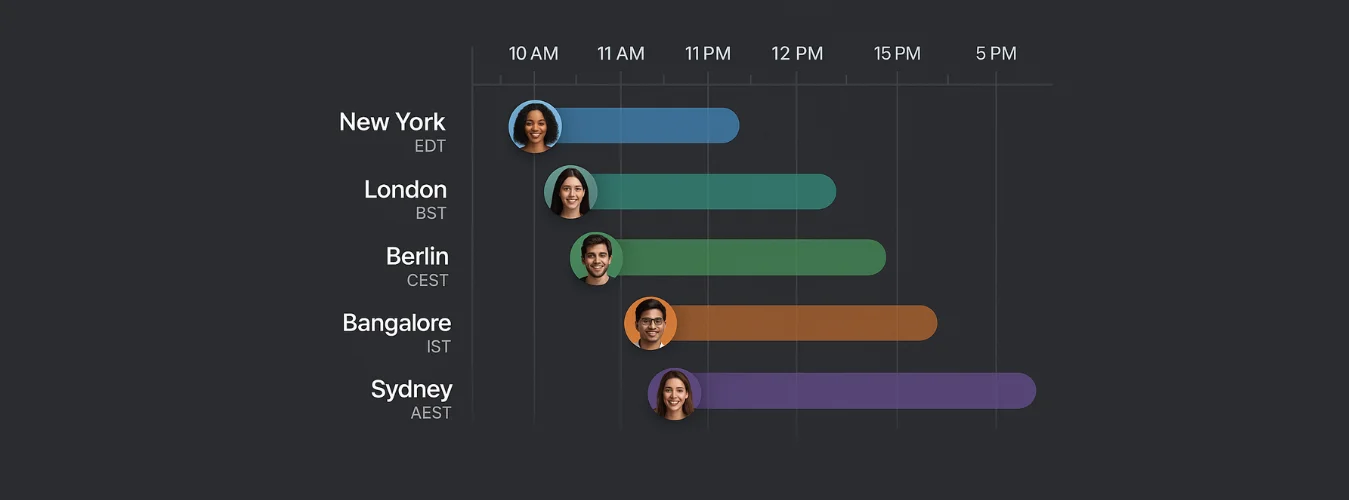
Accountability thrives on routine. Establish recurring check-ins that rotate to share the time zone burden fairly. Maybe your Monday standup is at 8 AM EST (manageable for Europe and the Americas), while your Thursday sync is at 5 PM EST (prime time for Asia-Pacific). No one team member should consistently take the hit.
Use these check-ins not to interrogate, but to unblock. Ask: “What’s in your way?” “Where do you need support?” Frame accountability as team success, not individual surveillance.
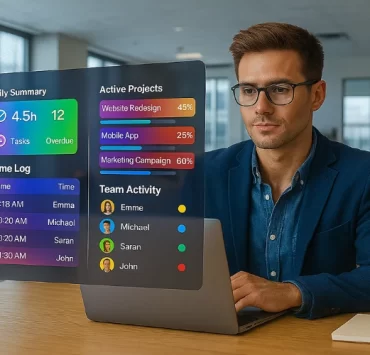
Pair this with lightweight remote employee tracking that monitors project milestones, not minute-by-minute activity. Tools like Handdy let employees log time on tasks, giving you insights into workflow bottlenecks without feeling invasive. If a task that should take 2 hours is consistently taking 8, that’s a signal to investigate, adjust scope, or provide training, not to penalize.
Trust, But Verify (Smartly)
Here’s the uncomfortable truth: not everyone will thrive in a fully autonomous environment. Some team members need more structure, clearer deadlines, or additional support. Remote employee tracking helps you identify these patterns early, before small issues become big problems.
But there’s a fine line between accountability and micromanagement. The key is focusing on results and behaviors, not screen time. If someone is consistently delivering quality work on time, does it matter if they logged in at 11 AM or took a two-hour lunch? Probably not.
Conversely, if deadlines are slipping and communication is sparse, tracking tools can help you pinpoint where things are going sideways. Maybe your developer is juggling too many tasks, or your marketer is waiting on approvals that never come. Data turns guesswork into actionable insights.
The Bottom Line: Accountability Is a Two-Way Street
Building accountability across five time zones isn’t about cracking the whip from afar. It’s about creating systems that empower your team to do their best work, wherever and whenever they’re working.
Remote employee tracking, when implemented thoughtfully, becomes a tool for empowerment, not enforcement. It gives your team visibility into their own productivity, helps you allocate resources smarter, and ensures no one is left wondering if their work matters.
So yes, your designer offshore can upload mockups at 3 AM. Your London PM can review them over morning coffee. Your Denver dev can integrate feedback by lunch. And your São Paulo marketer can sign off knowing the relay will continue seamlessly.
That’s not surveillance. That’s a well-oiled, globally distributed machine and the future of work. For more information on remote employee tracking, visit www.handdy.com
Frequently Asked Questions
1. How do you maintain accountability in a remote team across different time zones?

Maintain accountability by setting clear expectations, using asynchronous communication tools, implementing regular check-ins, documenting processes thoroughly, and establishing measurable goals with deadlines that accommodate all time zones.
2. What are the biggest challenges of managing a team across 5 time zones?
Key challenges include scheduling meetings that work for everyone, maintaining team cohesion, ensuring timely communication, preventing burnout from irregular hours, managing handoffs between time zones, and building trust without face-to-face interaction.
3. How often should remote teams across time zones have meetings?
Limit synchronous meetings to essential ones only—typically 1-2 weekly team meetings scheduled at overlapping hours. Rotate meeting times to share the burden of inconvenient hours, and record all meetings for those who can’t attend live.
4. How do you set clear expectations for remote workers in different time zones?
Document response time expectations, define core working hours, establish project deadlines with time zone considerations, create detailed task descriptions, and communicate preferred communication channels for different types of updates.
5. How do you build trust in a remote team that never works together simultaneously?
Build trust through consistent communication, transparency in decision-making, regular one-on-ones, virtual team-building activities, over-communicating progress, following through on commitments, and celebrating wins across all time zones.