

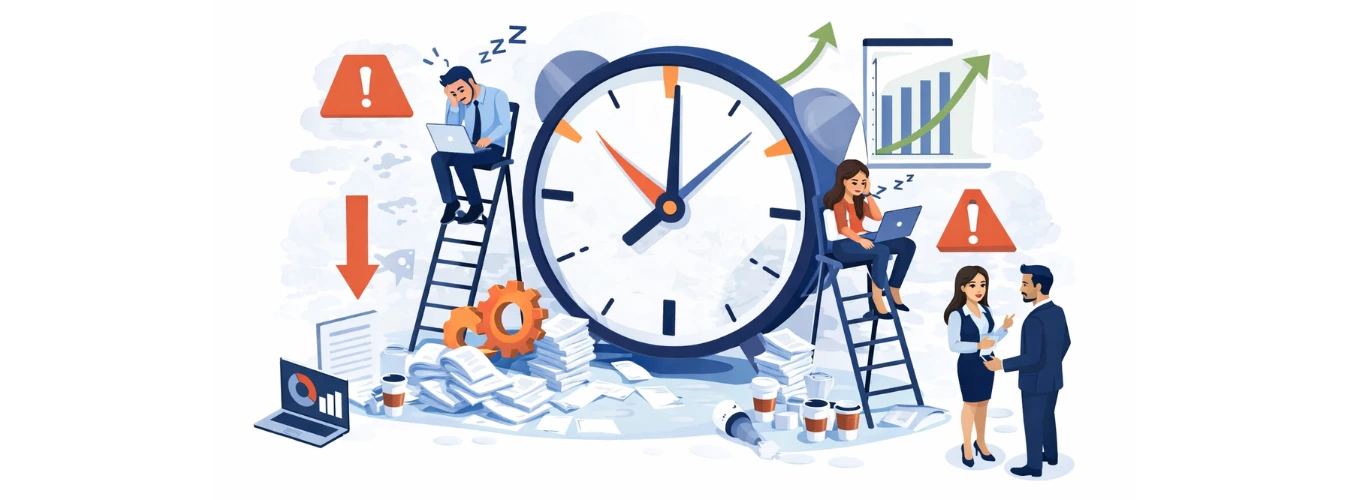

Some workdays feel strangely long and strangely unproductive at the same time. You’re in front of your laptop for hours, bouncing between meetings, messages, and tasks, yet the one thing that really mattered still isn’t done. By the end of the week, the calendar is full, the to-do list is longer, and you’re left wondering where all that “hard work” actually went. This disconnect is at the heart of the productivity paradox, and it’s exactly why productive time tracking is becoming such an important tool for modern teams.
Welcome to the productivity paradox – a world where longer hours don’t necessarily produce better results. In fact, they often do the opposite.
The Myth of More Time, More Output
For generations, we’ve tied productivity to time. If someone works longer hours, we assume they’re more committed, perhaps even better at their job. Managers praise “hard workers” who stay late, and employees often wear overwork as a badge of honor. Yet research repeatedly shows that after a certain threshold, every extra hour actually subtracts value rather than adding to it.
Fatigue sets in, creativity fades, and problem-solving turns mechanical. The mind starts to wander even if the hands keep typing. The body might be in the office, but the brain has already gone home. Ironically, many people spend hours doing “busy work”-endless emails, redundant reports, and shallow meetings, instead of making meaningful progress.
That’s why top-performing organizations are changing how they measure work. They’ve discovered that it’s not the quantity of hours that counts; it’s the quality within them. And to uncover that quality, they rely on something far more useful than old-fashioned timesheets – productive time tracking.
Tracking for Awareness, Not Surveillance
When people hear “time tracking,” they often imagine watchful managers checking who’s idle and who’s typing. But the future of productive time tracking looks nothing like that. It’s less about control and more about clarity. It provides teams and individuals with a mirror, a way to see where their hours truly go and how their energy ebbs and flows throughout the day.
Imagine realizing that your most effective work happens between 8 AM and 11 AM, while afternoons are filled with distractions and meetings. Or discovering that certain repetitive tasks quietly steal over five hours a week. When you can see these patterns, you can change them. That’s the magic of awareness.
Modern time tracking tools anonymize data, emphasize transparency, and focus on outcomes rather than surveillance. They reveal inefficiencies gently, like a productivity coach whispering insights, not a manager breathing down your neck. In that sense, they help employees regain control over their own rhythm instead of being slaves to the clock.
The Diminishing Returns of Endless Work
Here’s the unspoken cost of overwork: it numbs creativity. The human brain has limits — and once those limits are crossed, our capacity for innovation, empathy, and problem-solving collapses. In knowledge-based industries, mental clarity is currency; depleting it wastes more than time.
When employees stretch themselves thin, errors rise, and momentum slows. Rest becomes a luxury rather than a necessity. Before long, performance plateaus; not because people are incapable, but because they’re running on fumes.
The irony is that most organizations fail to notice this decline. They equate presence with performance. But being “always online” doesn’t mean someone is contributing meaningful value. In fact, the highest-performing employees often log out earlier because they’ve mastered productive time tracking, identified their peak working hours, and harnessed them effectively.
Rethinking Productivity as Rhythm
True productivity isn’t a straight line from 9 to 9; it’s a rhythm. There are bursts of focus, dips of fatigue, and pauses where the mind subtly recharges. When this rhythm is respected, with short breaks, creative pauses, and clear boundaries, output flourishes naturally.
Some of the world’s most innovative companies now design workdays around this idea. They don’t push for longer hours; they push for smarter structure. They encourage employees to do their most demanding tasks when concentration peaks and reserve lighter work for later in the day.
Productive time tracking enables this rhythm. It collects quiet, objective data that helps individuals identify their flow zones – times when work feels effortless and output skyrockets. Once teams align their schedules around those flow periods, productivity rises organically, without stress or overtime.
Balance: The Real Productivity Multiplier
One of the most misunderstood aspects of productivity is rest. Taking breaks isn’t a sign of laziness; it’s the maintenance routine of the mind. Just like a high-performance car needs occasional pit stops, humans need moments away from their mental engines.
Companies that embrace this truth often see surprising results. Employees who log off at a reasonable hour come back sharper, faster, and happier. Their ideas are fresher. Their problem-solving improves. Projects that once dragged for weeks start moving more smoothly because people aren’t operating on empty batteries.
Through productive time tracking, leaders can even notice when employees are stretching themselves too thin – frequent late-night logins, skipped breaks, or irregular working hours. That data doesn’t need to spark reprimands; it can spark care. Managers can initiate conversations about workload balance or provide resources for recovery.
From Counting Hours to Creating Impact
The old model of measuring productivity through sheer time is fading fast. Tomorrow’s successful organizations don’t count hours, they measure impact per hour. And that shift changes everything.
Instead of asking “How long did you work?”, they start asking “Did that time matter?” That question transforms work culture. It removes the guilt around leaving on time and replaces it with a deeper sense of ownership. Employees start striving for focus, not just presence.
Productive time tracking is the bridge to that mindset. It helps people see clearly what makes their hours count, which tasks drain them, and what moments spark their best contribution. When that understanding spreads across a team, miracles happen – collaboration improves, stress decreases, and results soar.

The New Definition of Working Hard
The real definition of working hard in the modern age is not staying up late – it’s about staying intentional. The best employees don’t chase hours; they chase progress. The best organizations don’t demand more time; they cultivate better energy.
The productivity paradox may seem unsolvable at first, but it’s really a matter of awareness. Once people start examining where their time goes and how they feel while spending it, long hours stop being a measure of worth. What takes over is smarter work, deeper focus, and meaningful impact.
Because at the end of the day, productivity is about doing what matters, well and wisely, within the hours that matter most.
For more information on productivity time tracking, visit www.handdy.com
Frequently Asked Questions
1. What is the productivity paradox?
The productivity paradox refers to the phenomenon where working longer hours actually leads to decreased output and lower quality work. Despite spending more time at work, employees often produce worse results due to fatigue, burnout, and diminishing returns on mental and physical energy.
2. Why don’t longer working hours lead to better results?
Longer hours don’t improve results because human cognitive performance declines significantly after 6-8 hours of focused work. Extended work periods lead to mental fatigue, reduced creativity, poor decision-making, increased errors, and lower overall efficiency—ultimately producing less quality output per hour worked.
3. How many hours should I work for optimal productivity?
Most research suggests 6-8 hours of focused work per day yields optimal productivity. The exact number varies by individual and task type, but working beyond 50 hours per week consistently shows diminishing or even negative returns on productivity and work quality.
4. What are the signs I’m experiencing the productivity paradox?
Common signs include: working longer but accomplishing less, making more mistakes, needing to redo work frequently, feeling constantly exhausted, struggling to concentrate, missing deadlines despite extra hours, and experiencing creative blocks or decision fatigue.
5. How can I break the cycle of working longer hours?
Break the cycle by: setting strict work boundaries, prioritizing high-impact tasks, taking regular breaks, using time-blocking techniques, eliminating low-value activities, delegating when possible, and measuring output quality rather than hours logged.